LMX // SIXTEEN LANGUAGES, ONE RUNTIME
Small languages. One runtime.
16 little languages that share a lexer, a parser and a sandboxed worker.
The file extension picks which one you are writing.
- 16interpreters
- 1runtime
01 / THE FILE PICKS THE LANGUAGE
Rename the file. Change the language.
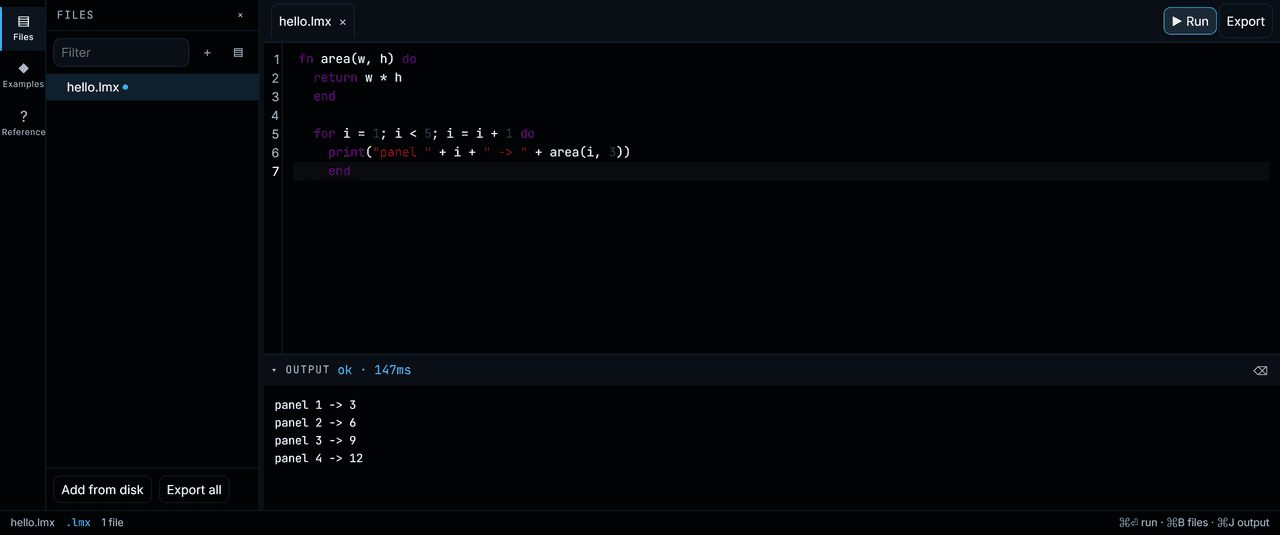
Rename hello.lmx to hello.lmm and the same runtime reads it as a matrix machine.
No configuration step, no project file.
set name = "world"
set n = (2 + 3) * 4
print("hello, " + name)
print("n is " + n)
Output
hello, world
n is 20
02 / RUNS HERE
7 of them run in this tab.
Runs in the browser sandbox, no account.
The server enforces that list before it reads a line of your script, and it is shorter than the engine considers safe — because safe means "no host access", not "fit to hand a stranger".
03 / NEEDS AN INSTALL
4 take their vocabulary from a live install.
Its vocabulary is a running Leumas install.
They read your data, spend your model credits and call your tools — .lmq, .lmai, .lma, .lmi. The anonymous sandbox refuses them, and says so.
Touches the host. Admin plus an explicit env flag.
04 / OFFLINE
One file. It carries its own runtime.
Nothing to install before it, and nothing left behind when you delete it.
Three lines to your first run.